
Annual Water Quality Report
Town of Hartwick Water System, P.O. Box 240, Hartwick, N.Y. 13348. The Town Board of the Town of Hartwick, acting as Water Commissioners, along with Mr. Grant Ward, Water Superintendent, are proud to give you this Consumer Confidence Report. This report is intended to be a snapshot of Hartwick's drinking water quality last year between January and December 2000. Safe drinking water is our primary commitment.
Why am I receiving this report?
Congress passed the Safe Drinking Water Act 25 years ago and gave the U.S. Environmental Protection Agency (EPA) the job of making rules — National Primary Drinking Water Regulations (NPDWR) — to ensure that drinking water in the U.S. is safe.
In 1996, Congress passed amendments that require drinking water systems to give consumers important information about their water, including where it comes from, what is in the water, and how your water quality compares with federal standards.
This report is brought to you in accordance with EPA's 40 Code of Federal Regulations, NPDWR parts 141 and 142.
What if I have questions about my water?
Our Town Board, acting as water commissioners, meets the fourth Monday of every other month, beginning in January, at 7:00 PM at the Hartwick Town Hall. Special meetings are called to handle any water issues that arise between regularly scheduled meetings. Meeting dates are posted on the board in the Town Hall and in the Freeman's Journal, the Town's official newspaper. The public is invited. You may also call Mr. Grant Ward, Water Superintendent, at 293-6618.
Where does my water come from?
The sources of drinking water for the Town of Hartwick include two wells. The first well, drilled in 1970, is known as the creamery well. This well is located near what used to be the Dairyman's Cooperative League Building, otherwise known as the creamery. This well was drilled to a total depth of 43 feet 6 inches and at last test was pumping 82 gallons per minute (GPM).
Speaking of the creamery, the creamery has become a source of some controversy this past year as the Board of Water Commissioners decides the fate of the building. The building is within the water right of way and therefore cannot be used for the storage of any items that could possibly contaminate the well. Additionally, the building is in a state of disrepair and the cost of refurbishing it could prove prohibitive. The Board of Water Commissioners therefore voted to have the building demolished. However, prior to the demolition of the building, any asbestos within the building must be identified and removed properly. It is at this point that the situation rests. No money has been expended to this point towards demolition, asbestos removal or refurbishing.
The second well serving the Town is known as the Fire House well. This well was drilled in 1982 to work in conjunction with the creamery well, plus to allow either well to be taken out of service for repair or maintenance while the other remained in service. This well is located behind Fire Co. #1. The total depth of this well is 137 feet, and was tested at 90 gpm.
Water from both of these wells is pumped directly into the mains, with any excess going into the storage reservoir. Once this reservoir is full the pumps automatically shut off and water is gravity fed through the system. This storage reservoir is located on East Hill and is a 150,000 gallon reservoir. It is estimated that it holds enough water to supply the Town for four days.
The Town of Hartwick owns the land around each well and the reservoir and restricts activities that can contaminate them. The State is assessing our source water for susceptibility to contamination and will complete this process by January 2001. We will let you know the results and where you may get a report.
Why must you treat my water?
Drinking water, including bottled water, may reasonably be expected to contain small amounts of some contaminants. The presence of contaminants does not necessarily mean that water poses a health risk. More information about contaminants and potential health effects can be obtained by calling the EPA's Safe Drinking Water Hotline at (800) 426-4791.
Water from the creamery well is treated with a liquid chlorine system for disinfection and bacteriological organisms. In addition, the Water Superintendent, working closely with the local District Engineer of the New York State Department of Health, has developed a corrosion control program to treat water from this well. Soda ash (sodium carbonate) is added to this water to adjust the chemical characteristics of the water. Water from the Fire House well is treated with a liquid chlorine system.
What contaminants might be in water?
Contaminants that may be present in raw or source water before it is treated are microbial contaminants, inorganic contaminants, pesticides and herbicides, radioactive contaminants, and organic chemical contaminants.
- Microbial contaminants, such as viruses and bacteria, which may come from sewage treatment plants, septic systems, agricultural livestock operations and wildlife.
- Inorganic contaminants, such as salts and metals, which can be naturally occurring or result from urban storm water runoff, industrial or domestic wastewater discharges, oil and gas production, mining, or farming.
- Pesticides and herbicides, which may come from a variety of sources, such as agricultural and residential uses.
- Radioactive contaminants, which are naturally occurring.
- Organic chemical contaminants, including synthetic and volatile organic chemicals, which are byproducts of industrial processes and petroleum production, and can also come from gas stations, urban storm runoff, and septic systems.
Are there contaminants in Hartwick's drinking water?
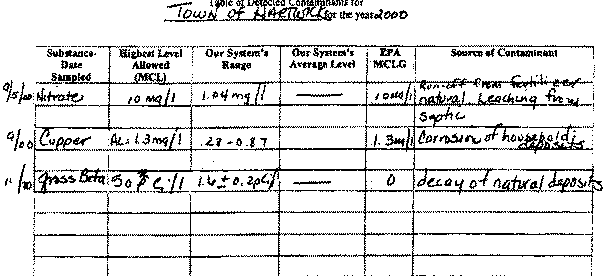
We are pleased to report that water quality from the creamery well has been excellent and has met all current NYSDOH standards. The Fire House well tends to produce water with a higher iron content, especially when it is pumped more than the creamery well. Iron is a naturally occurring element in groundwater and is more of an aesthetics problem (staining of laundry and plumbing fixtures) rather than a health related problem. The Water Superintendent has reported that customer complaints start to increase in direct proportion to how many hours the fire house well is pumped. Therefore, the Fire House well is only used to supplement the creamery well during the off-peak demand periods (i.e. night time) and is controlled by a time clock.
Is our water safe for everyone?
Some people may be more vulnerable to drinking water contaminants than the general population. Immuno-compromised persons, such as people with cancer undergoing chemotherapy, persons who have undergone organ transplants, people with HIV/AIDS or other immune system disorders, some elderly, and infants can be particularly at risk from infections. These people should seek advice about drinking water from their health care providers. EPA/Centers for Disease Control guidelines on appropriate means to lessen the risk of infection by Cryptosporidium and other microbial contaminants are available from the Safe Drinking Water Hotline (800) 426-4791.
What lies in the future for Hartwick's water?
In 1997, the Town Board retained K.W. Bunn Engineering to complete an extensive report about the water system. This report has proven invaluable for the Board in terms of planning improvements and maintenance of the system. In the past two years the Town has joined the New York Rural Water Association. This association has assisted the Town with leak detections, well head protection and testing, and the preparation of this report.
Most recently the Town has replaced the roof on the reservoir and cleared trees from close proximity to the storage facility. The Town Highway crew also improved the road leading to the reservoir to enable better access. The creamery well has been secured and the creamery cleaned of any motorized vehicles that may leak contaminants into the well. The Town no longer stockpiles stone or cold patch anywhere near the well. Signs have been put in around the creamery area designating this a no-parking area.
Currently, the Board of Water Commissioners is reviewing a proposed Local Law restricting activities on land surrounding a municipal well. The Board is still very much in the preliminary stages of this review. Before any such law is adopted, a public hearing will be held for public comment.
In November, the Town acquired a new water building for the Fire House well. This building will replace the small existing building. The new building will provide Grant Ward some much needed storage space and a nicer work environment around the well.
Additionally, the Water Commissioners have appointed a Water Advisory Board, made up of 10 water customers from various parts of the water district. As their name implies, this Advisory Board gives valuable input to the Water Commissioners in regards to policies pertaining to water. In the future, the Town is looking to replace older mains with 8-inch mains. This will be completed in phases as time and budget allows. Water commissioners are looking into the possibility of installing water meters in all homes and businesses to more accurately bill customers for water usage.
Attention Snow Birds
Although many residents do go away for some of the winter months, you will still be billed for the entire six months of service. However, you may contact the Town Clerk / water rent collector and have your water disconnected and therefore not be billed for the time that you have no water service.
Call before you dig!
When doing any digging around your home, remember that there are buried water lines. Please call Mr. Ed Rood, Highway Superintendent, for assistance in locating the water line. If by chance you or your contractor do damage a water line, you, the home owner, will be charged the cost of having the town Water Department repair any damage.
In summary
I hope that this report serves to give you, the customer, confidence in the Town's drinking water. If you have any questions in regards to this report, please do not hesitate to call the Town Supervisor at 293-8134. This report was prepared by Carol Niedzialkowski, Town Supervisor.
Definitions
- Maximum Contaminant Level (MCL) — The highest level of a contaminant that is allowed in drinking water. MCLs are set as close to the MCLGs as feasible using the best available treatment technology.
- Maximum Contaminant Level Goal (MCLG) — The level of a contaminant in drinking water below which there is no known or expected risk to health. MCLGs allow for a margin of safety.
- Action Level (AL) — The concentration of a contaminant which, if exceeded, triggers treatment or other requirements which a water system must follow.
- Treatment Technique (TT) — A required process intended to reduce the level of a contaminant in drinking water.
- Variances and Exemptions — State or EPA permission not to meet an MCL or treatment technique under certain circumstances.
- ppm — parts per million, or milligrams per liter (mg/l).
- ppb — parts per billion, or micrograms per liter (mcg/l).
- NTU — Nephelometric Turbidity Units (a measure of turbidity).
Mathematical Conversions
- 1 mg/l = 1 ppm
- 1 mcg/l = 1 ppb
- 1 ppm = 1,000 ppb
The amounts of a contaminant allowed in drinking water are so small they are measured in ppm — equivalent to one penny in $10,000,000 — or ppb — equivalent to one penny in $10,000,000,000.
* The State allows us to monitor for certain contaminants less than once per year because the concentrations of these contaminants do not change frequently. Some of the data, though representative of the water quality, may be more than one year old.
** Water containing more than 20 mg/l of sodium should not be used for drinking by persons on severely restricted sodium diets.